Back to slave camps Intro
Alphabetical List of camps firmen_lager.xls
Babenhausen - Krs. Illertissen; US zone;
CWC: "Baufirma Trucksaess" of 120 person in 1944-5
Babiy Yar, Kiev, Ukraine (of course the Ukrainians were blamed for this) "On September 19, 1941 the Fascist troops occupied Kiev, and in 10 days, on September, 29 they started to shoot civilians in Babiy Yar. According to German documents, in two days 33,771 Jews were killed. The ravine was turned into a burial place of Jews, Russians, Ukrainians, Hungarians, Czechs, Gypsies, prisoners of war, patriots, mentally handicapped and ill people. The Nazi did not even spare children, old people, pregnant women. According to historical data, over 100,000 people were interred on the lands adjoining Babiy Yar. Some of victims were buried alive."For more info: http://www.kiev.info
KZ Bad Gandersheim http://www.gandersheim-city.de/
http://home.t-online.de
Bad Grund
Bad Harzburg City administration is in the forest meadow 5, Bad Harzburg. Whether the archives are also there, I do not know. MfG Fleger
http://www.bad-harzburg.de/
Bad Kissingen - Krs, Bad Kissengen, US Zone
Prison: Amtgerichtsgefaengnis
Bad Lippspringe Nordrhein-Westfalen
Bad Nenndorf Trial of British staff a Civil Internment Camp Bad Nenndorf (in German)
http://de.wikipedia.org
Submitted by: Alan Newark braveheart562002@yahoo.com
Bad Schandau - See Porschdorf
Barbing - Krs Regensburg; US zone
Forced labour camp :"Fliegerhorst";1942-45 350 Men
Baulager 1 [Wohlanger 1] -www.walpersberg.de/lager-1-2/
Bayreuth - Krs. Bayreuth; US zone
CC Kdo of Fossenbuerg, Arbeitslager Bayreuth, Institute f. physikalische Forschung i.d. Neuern Baumwollspinnerei, Zeutsrale: Forschungl- und Verwertungsgesellschaft mbH. Berlin W. 15, Knesebeckstrasse 48/49; Beyreuth, Karl Schuellaenrstrasse 54 Bayreth. Average strength of the Kdo. 50 prisonsers,
Prison: Strafgefaengnis und Arbeisthaus St. Georgen
CWC: Neue Baumwollspinnerei, Carl Schullerstrasse 54l. 1940-42 16 men and 174 women
Knorr GmbH, Nachmittelfabrik Inselstr. 25, 1945-45; 5 men and 20 women
Mechanische Baumwollspinnerei, Brandenburgerstrasse 2; 1942-45 35 women
Bayreuther Bekleidungsindustrie, Badstrassre 34; 1943-45, 50 women
Belzec - Death camp in Poland
Bergedorf
Bergen-Belsen KZ - Collection point; April 1943 - April 1945; est. deaths 70,000; 2 subcamps; see http://www.bergenbelsen.de/
https://en.wikipedia.org
Vimeo film: Memory of the camps
54:28 --- Aushwitz and Bergen Belsen
55::?? --- Here 4 million people were starved to death (Men, Women ad Children)
55:?? --- Sound stoppes
55:30 --- The final reels were filmed by Russian cameraman and the Film/reels are MISSING? But the script is in tact.
55:52 --- Sound returns
Bergison Gladbach
Berga Concentration Camp
Berga an der Elster is in the Greiz district
of the state of Thuringia, Germany. In World War 2 it was a sub-camp of Buchenwald. It
was also was used as a sub-camp for Stalag IX-B, which was, nominally at
least, an ordinary German military prisoner-of-war camp. However, many American
Jewish prisoners of war were sent there, and it had a reputation for being
an appalling camp. The camp's code name was Schwalbe
V. http://en.wikipedia.org
In World War II a slave labor camp called "Berga an der Elster"[2] was operated here to dig 17 tunnels for an underground ammunition factory. Workers were supplied by Buchenwald concentration camp , and from a POW camp, Stalag IX-B . The latter was in contravention of the provisions of the Third Geneva Convention.
Many prisoners died as a result of malnutrition, sickness (including pulmonary disease due to dust inhalation from tunnelling with explosives) and beatings, including 73
The labor camp formed part of Germany's secret plan to transform, via hydrogenation, brown coal into usable fuel for tanks, planes, and other military machinery. However, the camp's additional purpose was Vernichtung durch Arbeit (or "extermination through labor, and prisoners were intentionally worked to death through inhumane working and living conditions and starvation. This secondary purpose of extermination was carried out up till the end of the war, when the prisoners were put on a forced death march to keep ahead of the advancing allied forces.
Berga was run by a fanatical German national guard sergeant named Erwin Metz, who was responsible for the inhumane conditions and who gave the order to take the prisoners on the death march. When the allied forces closed in on the retreating Germans, Metz deserted his post and attempted to escape by bicycle, fearing the consequences of being captured in possession of the remaining Berga prisoners and having to answer for his war crimes. Still, he was captured days after the prisoners were liberated by American forces and was sentenced to death.
However, due to the American political climate and the war department's shifting priorities towards defending against the Soviets in the lead up to the Cold War, many German war criminals' sentences were commuted in exchange for intelligence that the Western allies believed to could be used against the Soviets. Metz was therefore only imprisoned for 5 years before being released back to Germany a free man.
kilroywashere.org
http://www.jewishvirtuallibrary.org/jsource/Holoc
Berlin
Bibra - Auslanderlager Bibra or Lager VIII - https:www.walpersberg.de
Bielefeld Nordrhein-Westfalen
Birgsau - Krs. Sonthofen, US zone; situated 5 miles south of Oberstdorf
CCK.do of Dachen, working for Zentralbauleitung der Waffen-SS,
Kdo. Oberstdorf-Birgsau; first mentioned 5/11/44, average stregth 30 persons
Blaichach - Krs. Sonthofen; US zone;
CC.Kdo of Dachau - working for BMV Blaichach; average strength until Feb 45: 700 prisoners, then 400 prisons in 1945
Blankeburg (Restkreis) - Russia zone; kdo. Buchenwaldl,
Bocholt
May 2013
I have to tell you that we work on a book about the camp in Bocholt and we are always searching for photos for the book. Publishing date somewhere in 2014. The camp doesn't exist anymore. Now it is a forrest.
Kind regards
Marius (Lange) from Bocholt mariuslange@gmx-topmail.de
Bochum Nordrhein-Westfalen
Böckingen
Boizenburg
Bonn Nordrhein-Westfalen
Börgermoor
The first Emsland camp opened in June 1933 and was marked by especially brutal conditions.
In April 1934, the facility was changed into a prison camp for criminals, homosexuals, Sinti and Roma (Gypsies), and those condemned for high treason.
In September 1944, 400 Night and Fog prisoners (western European resistance fighters) were deported to these camps.
Brand
Civian Workers Camp in Aachen (British Zone)
Brandenberg / Brandenburg -
Brandenburg City Archive -Stadtarchiv Brandenburg
Potsdamer Strasse 16
D-14776 Brandenburg
Tel: +49 (3381) 584 701
Fax: +49 (3381) 584 704
See also KZ Ravensbrück and KZ Sachsenhausen
Beeskow -Storkow - Russian zone
Wendish Riettz - is a municipality in the Oder-Spree district, in Brandenburg, Germany.
The history of this village at the bottom end of the Scharmützelsee lake about an hour from Berlin is all there in the name. The Wends were West Slavs, who settled in the land between the Elbe and the Oder rivers over a thousand years ago. Divided into a number of different tribes, they were the majority population of the area that now makes up most of the state of Brandenburg until the arrival of German colonists between the 12th and the 14th centuries. By the 18th Century most of the Wends had been assimilated into the German population, except for the Sorbs, who continue to live as Germany’s only indigenous minority in the Spreewald region, not far from Wendisch-Rietz.
Who knows how many people in this holiday town have Slavic roots, although the Nazis didn’t like the idea and changed the name of the town to Märkisch Rietz until it was reverted back in 1945. From then until 1990, the little town at the bottom of the lake was part of the German Democratic Republic, and there are traces of the socialist period still to be discovered to this day.
For more: underagreysky.com
Braunschweig -
Bruekenau - Krs. Bruekenau; US zone
prison: Gerichtsegefaengis
CWC: Saegewerk Philipp Vorrndran, Jun 1942-45; 50 persons
Brunswick -
submitted by: Alan Newark braveheart562002@yahoo.com
Detention and work camps in Brunswick
IN GAUSSBERG 1 - JEW'S HOUSES
Between 1939 and 1941 the Jewish population of all human rights was robbed.
After the restriction of the rent (spring, 1939) they became
so-called Jew's houses, listed here:
· in the Gaussberg 1,
· Neuer Weg 9,
· Meinhardtshof 3,
· Höhe 3,
· Hamburg Str.298,
· Hagenbrücke 6-7,
· Ferdinandstr. 9,
· Hennebergstr. 7 and
· Wendenstr. 2
They were packed together, from September, 1941 by collective transports to the destruction camps eastwards.
About the stupefying destiny of a group of Brunswick Jews report an
eyewitness who was official-obliged till the end of 1944 in a coal hydrier
factory close to sweating out as a department manager:
'On the food maps there were sometimes the special allocations, soap or such a thing which were delivered on call. Because I could not perceive them because of my service, I announced myself in 1943 to Brunswick, so that my relatives could come to enjoy special allocations. To the notification of change of address I proceeded in the police station in the Celler street/corner ring. When the official saw that I announceed departure from Heydebreck (near Auschwitz), he looked at me suddenly quite anxiously and said: ' There I have also been. ' I said: ' Nevertheless, you have not hopefully brought the last Brunswick Jews after sweating out?! 'There he caught in to howl. If they introduce themselves, a police officer! But he was an auxiliary policeman and apparently very devoutly. 'The man's God may forgive me', he said, ' I do not get over it'. I asked: ' What has happened then? Was this the train from which the Jews have waved out and where the SS to those has the bones destroyed ? ' - This had happened because the Jews thirst and had asked for water.
This policeman had accompanied the Jew's transports from Brunswick as a marking person; to Berlin everything has been quiet, but the Berlin Jews who have got on would have known where it went. Then this would have become a dreadful journey to sweating out.
I asked: 'What has become then from them?' and he said: 'They have been gasified everything, everything are away.' (Interview with H. Sommer, in 1981)
But also during the following years the Nazi rule and the war begun by her demanded thousands of human lives. Under in the prison in Wolfenbüttel of executed are many victims of the National Socialist arbitrariness justice and war justice. Numerous foreign members of the resistance also belonged to the executed. On the area of the Army of the Reich in Salzgitter 3400 foreign prisoners of war, prisoners and foreign workers died. 138 of them were executed. On the Brunswick foreign cemetery in the Brodweg there lie anonymously foreign forced laborers and prisoner of war. Also on the old Catholic cemetery in Hochstrasse Polish forced laborers are buried anonymously. Forty air raids on Brunswick took 2900 bomb victims. The city had to deplore to 5244 favour.
On the main cemetery graves and memorials remind us of these events.
"Are watchful - with it our death in vain was not" is the inscription
of a stone tablet of the Rieseberger victims, urns in 1953 on the Brunswick cemetery would cross have become. An honourary grove reminds of the dead people.
CONCENTRATION CAMP: Example: SCHILL monument, Schillstreet
By the rearrangement of the industry to complete armament production
and for construction work or clearing work outside camps of the concentration
camps were moved in the factories themselves. The NS terror was exercised
here, often under the eyes of the population and under their co-operation,
after the principle of the exploitation of the human worker and the destruction.
In the city borders of Brunswick there were as can be proved four outside
commands of concentration storage:
· concentration camp-outside command Lager Schilldenkmal (Schillstrasse,
today's working area of the post, more than 800 prisoners),
· concentration camp-outside command SS riding academy (with
the forced laborer's camp in the Salzdahlumer street, approx. 750 female prisoners),
· concentration camp-outside command troops economy
camp of the Waffen-SS (about 10 prisoners)
· concentration camp-outside command SS-young nobleman's
school (in the Schloss castle).
The first three camps being subordinate to the concentration camp Neuengamme, the last of the concentration camp Buchenwald.
FORCED LABORER'S CAMP: Example: Griegstreet
To the backup of the agricultural products and as a substitute with missing
industrial workers about eight millions foreign manpower (civil
worker, forced laborer and prisoner of war) were used in the Large-scale
German empire. From the numerous camps also in Braunscheig some tracks
have still been preserved till this day and serve, among the rest, the
accommodation of late emigrants, how in Griegstreet.
In particular the
Brunswick Büssingworks (later MAN) used the possibilities of the application of forced
laborers fully. Of it the following camps are known:
· Camp Mascherode, Salzdahlumer street/corner Griegstreet (approx. 1200
persons);
· several camps in Kralenriede (Rühmer Berg, Steinriedendamm, Schuntersiedlung, approx. 2000 persons).
All together nearly 50 'civil worker camps' existed
at Brunswick companies for foreign forced laborers. Biggest from them
were:
· the communal camps of several companies in the Frankfurt
street and on the Schützenplace,
· the camps Kälberwiese and Baumschule Lehndorf of the MIAG and
· the camp of the optical works Voigtländer and Son in the Berlin
street.
In the following big 'civil worker storage' were accommodated with
end of the war between 400 and 1800 foreign forced laborers:
· national railway office of Brunswick, Campestr.41;
· camp of the public utilities Brunswick;
· Volkswagen-Vorwerk, engine factory, Gifhorner street;
· Wilke-Werke AG, Bahnhofstr.15;
· ' camp red meadow ';
· Lutherwerke, in the west railway station.
In the remaining 'civil worker storage' were accommodated with end of
the war between 60 and 260 foreign forced laborers:
· airplane repair work Brunswick, Zimmerstr.24;
· machine factory Viga works, Hamburg Str.260;
· machine factory of Karges and Hammer, Frankfurter Str.36;
· Chem. Factory Eisenbüttel, Frankfurter street;
· calculating machine factory Grimme&Natalis, Kastanienallee;
· iron construction Krüger&Co, Rosenstreet; metal pots factories:
Unger&Sohn, Ernst's Amme street;
· Schmalbach, Hamburg Str.38;
· Bremer&Brückmann, Juliusstr.1;
· Deutsche Asphalt AG, Friedrich's Wilhelm place 1;
· construction industry Carla Weiss, Broitzemer Str.37;
· saw work Siegburg, Kurze Kampstr.16;
· wooden goods and leather goods Schubert, Geysostr.19;
· jute spinning mill, Spinnerstreet;
· soap factory of Joh.Fr.Weber, Hildesheimer Str.10;
· sugar factory ' camp Eichtal ', Celler Str.65;
· big butcher's shop Struck&Witte, Berliner Str.2; · Schaare,
Saarbrückner Street;
· canneries: Maseberg, Goslarsche Str.61;
· Querner, Wilhelmstr.31;
· Meinecke, Celler Str.54;
· Grahe, Bültenweg 77;
· Heine&Lindner, Gliesmaroder Turm;
· Jentsch&Sohn, Kreuzstr.17;
· Naujoks, Helmstedter Str.92;
· Daubert, Helmstedter Str.97 and Wiesenstr.1;
Also this list is not entire yet!!!
About the inhuman conditions of foreign workers and prisoners of war gives the report of inhabitant's of Brunswick information whose parents helped these people in their misery, although this was prohibited by law:
'With us on the street were done to construction work by prisoners of war. They were hard guarded. If somebody went past with them, they whispered 'b read! Bread! '. They suffered hunger. Although we also had enough hunger, then my mother tried to help them. Of course nobody might see this, because one might not help prisoner, talk not even to them. My mother made it completely ingenious: She cut breads, it wrapped and took them with on the way to the shopping. In the meantime, with a prisoner she had taken up eye contact. Blinked them to, took the muffled bread and threw it in one in that standing garbage metric ton sews. There the prisoner knew give and could get later the breads. Against the fact that the prisoners examined the garbage metric tons after comestibles the guards had nothing.
My father co-operated in a company important to war in the city with Ukrainian foreign workers, partly were the 14-year-old children whom one supplied not properly.
There was all food on stamps during the war. Thus the possibility was to be helped, very much restricted. Only with the meat trader there was sometimes quite awful mussel meat, undefinable stuff. My father ate it, and he took it in the cooking dishes with in the company for the Ukrainian youngsters. Also this had to happen secretly.
(Citation from Reinhard Bein: Free state Brunswick in 1930-1945, Döring printing, Brunswick)
Bremen
Breitenau - "Early wild camp" June 1933 - March 1934; est. prisoners 470;
then labour camp; 1940-1945; est. prisoners 8500; see: http://www.gedenkstaette-breitenau.de
Bronn - Krs. LPegnitz; US zone;
Forced labour camp of OT
Buchberg Kdo. (Kommando) Dachau, Zivilarbeiterlager (Civil
work camp); US zone
2 miles S of Gelting, 3 miles east of Neufahrn
Lager Buchberg, worked with armament industry*, from 1940-45 600
workers, partly POW, partly civilian; write to mayor in Gelting
*Probably the armament plant, DSC, was situated in the fir forest of Foehrenwald,
within the triangle of Wolfrathausen, Gelting, and Neufahrn;
CC Kdo Dachau had a smaller Kommando in the factory named SS Arbeiterlager (work
camp) Neufarn
Buchenwald - labour camp was very big; July 1937- April 1945; est. prisoners 250,000; est. deaths 56,000; with a lot of subcamps:
· Kdo.of Buchenwald
· Civilian Worker Camps Zivilarbeiterlager
· Consentration camps https://en.wikipedia.org
· Eisenbahnbaubrigade I - Baubrigade IV - transferred to CC. Dora Oct 10, 1944 - See Dora
· Konzentrationslager
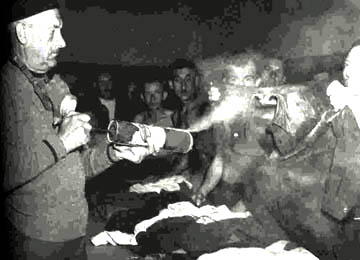
Spraying for lice
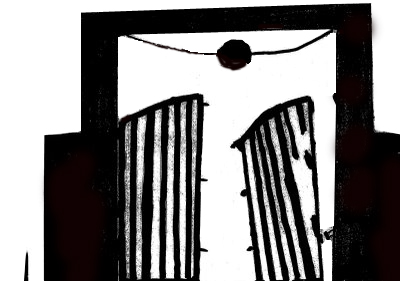
"I want to bow to my father, Andriy Andriyovych Yushchenko, for the lessons he taught me. He was a teacher in the small village of Khoruzhivka, in Sumy Region. He also was a prisoner in Auschwitz, Dachau and Buchenwald. My father's truth has led me through life to the high honour of becoming the leader of my country," from inauguration speech of Ukrainian President Viktor Yushchenko, January 23, 2005.
"My father never met a guard he would forgive. They were brutal men who beat him and killed his friends for no reason. One sub-zero winter night, these guards ran roll calls over and over. Hundreds of prisoners in pajama thin clothes stood outside in the cold and snow. By morning, about a hundred prisoners were dead," by John Guzlowski. "When my father was dying in a hospice, there were times when he was sure that the doctors and the nurses were the guards who beat him when he was a prisoner in the concentration camp. There were also times when he couldn’t recognize me. He looked at me and was frightened, as if I were one of the guards."
I posted a new blog essay
about my father's time at Buchenwald. This is the anniversary of
the liberation of that camp. hghtning-and-ashes.blogspot.com
Dr. John Z. Guzlowski
Professor Emeritus
Eastern Illinois University
A youtube of my reading poems about my parents and their experiences in
Nazi Germany
http://www.youtube.com
Aug. 9, 2019 Hi Olga,
Thank you very much for all of the info that you sent me! I didn’t know that a search [International Tracing Service [https://arolsen-archives.org/en/ ] was available for me to look into my father’s locations!
He spent that time in 4 concentration camps, witnessing “Hell on earth”. They were Buchenwald, Dachau, Flossenberg and Gross-Rosen.
Thank you again for developing this website.
I sincerely Thank You!,
Mary Wenger marywenger@mymts.net
Buchloe - Krs. Kaufbeuren, US Zone
Prison: Gerichtsgefaengnis
Work detail of 200 Civilian internees worked with the Reichsbahn (railroad)
Buckenhof - Krs. Erlangen, US zone
CWC: a POW camp - French POWs 1942- 1.7.43 released as civilian workers from 1.7.43; 1945 120 men
Celle
City archives Ansprechpartnerin: Mrs. Sabine Maehnert Effnungszeiten,
Westerceller Str. 4 D-29227, Celle
Telephone: (05141) 936 00 0 FAX: (05141) 936 00 29
E-Mail: stadtarchiv@celle.de
http://www.celle.de/
Chelm - Death camp
Chemnitz - https://en.wikipedia.org
• CC Kdo of Flossenburg, Astra-Werke, GQ, Tel 52451, 10) Chelmnitz, Alt-Chemnitzstrasse, 41. Established 1944, the Kdo had an average 500 women in prison in January - March 1945
• CC Kdo of Dora, starting Oct. 28, 1944, with 514 prisoners. On April 8, 1945, the brigade arrived at Plattling on their way from Chemnitz and continued railway repair work in Ittling, where it was liberated on May 4, 1945 (notes from Netherlands Red Cross).
• Prison - Untersuchungsgefaengnis
• CWC (Civial Workers)
Austra-Werke AG, type of work: Mech. ind. ; average people 500, (1944-1945)
Auto-Union, Rosserlerstrasse 27
Russian zone after WW II
Jul 28, 2019 Dear Olga,
I was listening to old tapes of conversations I had with my mother, Klementina Suchorska, about her years in Germany during the War, something I remembered and something she said off-handedly gave me enough information for me to start a search.
I know that between 1942 and the end of the War, she was making ordnance in a factory owned by Gebruder Länger. The factory was on Limbacher Strasse, Chemnitz. I would like to contact anyone who was there too or to their family member who knows anything else about the factory. Would you post my message?
Chris Burda christina.burda@yahoo.com
Colditz -- the
bodies were found: http://home.t-online.de
From 1939 to 1945, it was the prisoner of war camp for officers Oflag IV
C. The events are documented in the Fluchtmuseum (escape museum). The museum
is open to visitors for history and a guided tour of the castle. It's best
to phone the castle administration before coming. In this way one best can
learn, why every schoolchild in England knows about Colditz castle.
HASAG armament factory and a forced labor camp
Cyprus
A well-known Jewish camp on Cyprus. The exodus of
Jews from Europe to the Promised Land was thwarted by Great Britain, which
blockaded the shores of Palestine to prevent thousands of Jews from entering
the ountry. In August 1946 Great Britain's foreign minister, Ernest Bevin,
ordered that boats of migrants be intercepted and escorted to the island
of Cyprus, where the "illegal" Jews were placed in internment camps. The
American-Jewish Joint Distribution Committee was allowed to enter the camps
and provide residents with aid and relief. From Displaced Persons Camp Money by Frank Passic and Steven A. Feller.
British authorities approved the use of internal money as payment to residents who worked within the camps.
ZYPERNLibrary Association of Cyprus
POB 10 39
1105 Nicosia
Letzte Änderung
Continue to slave camps page D-G